
“It’s quite likely that I shall stay in this colony for good – I may even leave my bones to lie whitening on the plains far inland.” Ludwig Leichhardt, Explorer
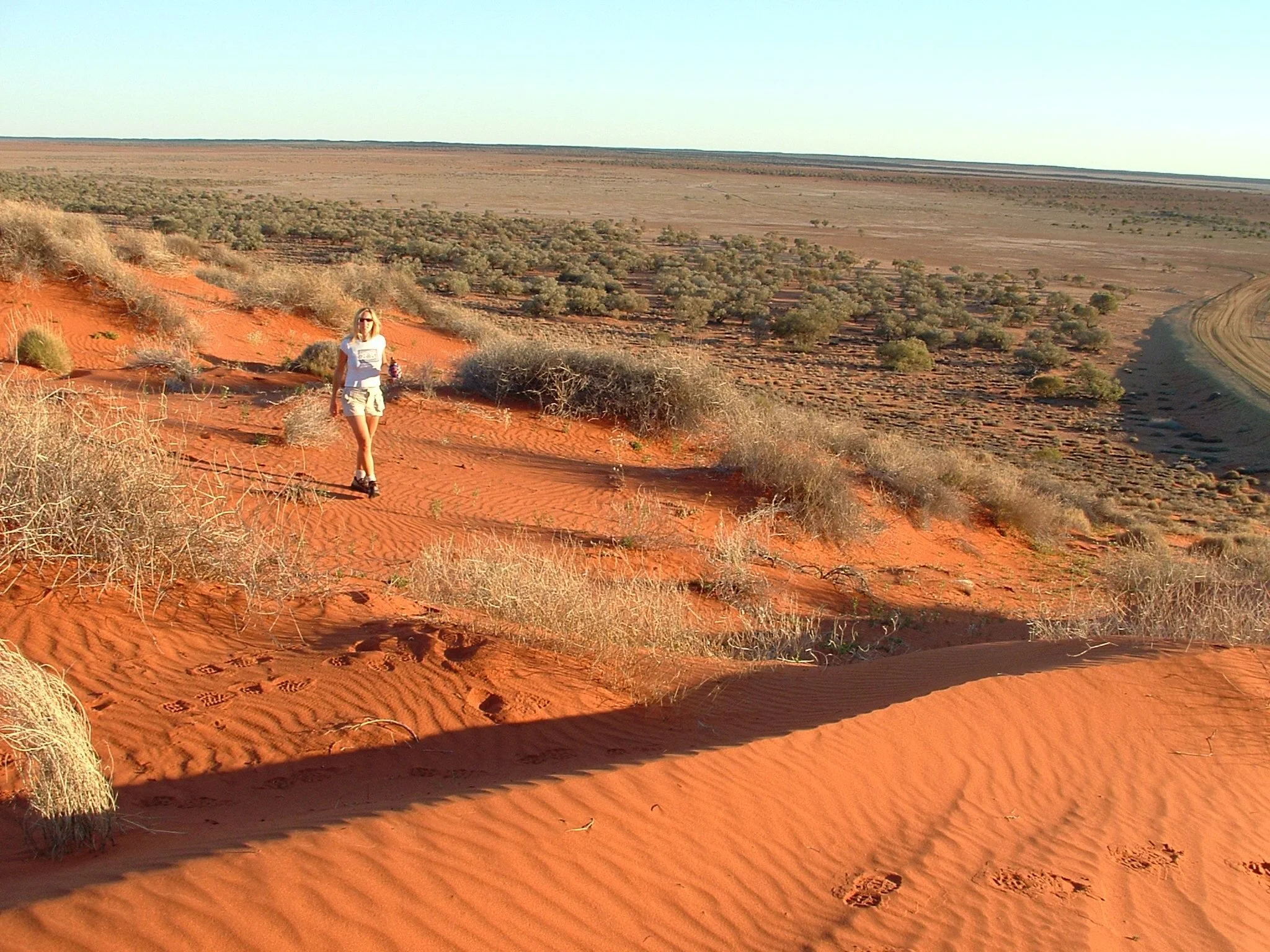
Bull dust swirled in through the cracks of the windows and bush flies landed on the corners of my mouth. I swatted at them automatically and began to nod off on a bench in the back of the Land Rover as Chris, Adam and I bumped along the Plenty Highway. Highway, was a misnomer, conjuring up a paved interstate back in the United States. The Plenty, running 300 miles between Alice Springs and the outback town of Boulia, was more of a glorified track skirting the northern edge of the Simpson Desert, a stretch of red earth, sharp rocks, and talcum powder fine dirt as treacherous as a patch of ice.
The explosion of the tire was amplified by the surrounding quiet. The vehicle careened to the left, jerking me along with it. “Crikey,” Adam said to Chris. I looked out of the back window to see our trailer of film equipment now airborne. I looked at the metal box across from me. It contained the tools that Chris might need to fix the Land Rover if we broke down in a place where another vehicle might not pass by for days, precisely where we were. It looked to be just about my size. I jammed one hand against the roof and wedged my boot on the edge, thinking, (“This is going to hurt like hell when it comes crashing down on me.”)
How had I ended up on the verge of death in the middle of nowhere with two people I barely knew?
_______
Four year earlier, my brother Ben and I and our two guides had rolled into Darwin after finishing Leichhardt Expedition 2000. We had spent the last six weeks in a 4-wheel drive vehicle, retracing the expedition that my great, great, great grand uncle, Ludwig Leichhardt, led in 1845 by foot and horseback. After 3,000 miles of struggling to find food and water, enduring intense heat and surviving a fatal Aboriginal attack that killed one of the men in his party, Uncle Ludwig and his ragtag group straggled into Port Essington, a remote British settlement in northern Australia. He was a Prussian exploring in an English colony and snubbed for having the audacity to do so. Long given up for dead, when he sailed into Sydney he was welcomed as a hero. “Leichhardt lives!” the people shouted.
But not for long. Just three years later, he and his six men, seven horses, 50 bullocks, 20 mules and mob of kangaroo dogs vanished into the outback on his third expedition while attempting to be the first “white fellow” to cross the heart of the continent from east to west. It is one of the great mysteries in exploration.
I was 12 years old when I found out that I was related to this famous person. Ben and I were standing in the kitchen in our house in Louisville when my Mom, Letty Lee Leichhardt Williamson Ransdell, set a book on the table. “Uncle Field brought this back from his trip to Australia. It’s about the explorer Ludwig Leichhardt. You’re related to him.”
Mom got an acting scholarship to a private Baptist college in Kentucky, and although she left early to marry my Catholic dad, the “crossback” as Granddaddy Leichhardt referred to him, she always had a sense of the theatrical about her. “He disappeared in the desert never to be heard from again,” she said, enunciating each word as it slowly peeled off her tongue. Our house never lacked for drama. There were five kids, our dog, Pepper, our cat, Cinderella, and as many snakes, hamsters, turtles, mice and God’s creatures as my mother would let me brother Jamie have. Not to mention, one stepfather, always impeccably groomed, who drank every day. Something dramatic was always happening. But this was good drama.
Ben and I made a verbal pinkie shake right by the sink full of dirty dishes that one day we would go to Australia and find out what happened to Uncle Ludwig.
Unlike Uncle Ludwig on his Port Essington expedition, on my expedition I had not suffered from prickly heat and boils. I had not had to walk over rocky terrain after my horse drowned in a freak accident. Aborigines had not attacked my party and killed Ben or one of my guides. Still, I could relate to the words that he wrote in his journal when he finally reached Port Essington on December 17, 1845, “I was deeply affected in finding myself again in civilized society, and could scarcely speak, the words growing big with tears and emotion.”
I felt just like Uncle Ludwig when we pulled up to the hotel in Darwin, the Land Rover, covered in dust, our swags and gear strapped to the roof rack. In the process of my journey, I had ended up somewhere else, and it wasn’t just Darwin. Intellectually, spiritually and emotionally, I felt like I was somewhere else.
Letty Lee had flown to Australia to meet us at the end of the expedition and was standing in the portico as we got out. She ran to Ben and wrapped her arms around him. “My beamish boy!” He looked like the actor Patrick Swayze (people often thought he was), and had the physique of an Aussie footballer, but my mother stilled gushed over him like she did when he was an always-smiling, towhead toddler. She then came over to me and put one hand on each of my arms and stood back. “Carrie, what happened to your hair?” I’ll admit it looked like straw. A gravity shower, a bag filled with bucket of water from a nearby stream and strung from the branch of a Mulga, was no match for dust and sun in the desert.
But I wasn’t going to have time for reflection. Leichhardt Expedition 2000 was big news in Australia, and I was being interviewed yet again, this time by a reporter for the indigenous station, Imparje Television. The cameraman was a cool-looking Aboriginal dude with wild black hair. After we wrapped up the shoot, he came over to chat. He handed me his card with an email address and name written on the back. “You’ve got to meet my mate, Chris Tangey. He knows all about the explorers. I’ll bet he can help you find out what happened to Leichhardt.”
Since then, I had struck up a cyber-friendship with Chris. He was a documentary filmmaker in Alice Springs who had spent years searching for the camps of the also ill-fated Australian explorers, Robert O'Hara Burke and William John Wills. Their expedition had skirted the eastern edge of the Simpson Desert in 1860 while crossing the continent from Melbourne in the south to the Gulf of Carpentaria in the north, surveying the land for a possible route for the Australian Overland Telegraph Line. They had died from starvation and exhaustion on the banks of Cooper Creek, but unlike Uncle Ludwig, were found.
Six months earlier he had emailed me to say he was headed into the outback to investigate some remains found in a massive clay pan that his mate Robbie Dare, a descendent of the one of Australia’s pioneering families, had discovered after years of searching. The remains could be one of the twenty-six camels that the explorers Burke and Wills traveled with. Did I want to join him on a recky?
I met Adam at Chris and his wife, Annie’s house. They had kindly offered me a place to stay before going bush. I had just gotten back from a run. I was hot and sweaty and red dirt caked my shoes. Chris was sitting at the kitchen table with a guy.
“Hey, Carrie, I want you to meet my mate, Adam. He’s an anthropologist and photographer. I thought he might want to join us for the recky.”
“I know all about you,” Adam said. “I’m good mates with Brendan and Nerida.” Brendan and Nerida were my guides on the Coburg Peninsula leg of my expedition, a sacred piece of land where wetlands stretch from one rock outcrop to another and Magpie geese float with the crocodiles.
The next morning, Chris, Adam and I departed for The Plenty.
__________
We shot into the desert like an arrow leaving a bow, Chris fighting the wheel as we tilted sharply to the right. Bam! We were on, then off, all four wheels, skittering across the sand and spiny clumps of spinifex before finally coming to a bumpy stop seconds later. No one said a word. With dust still billowing around us, I climbed down and joined Chris and Adam to stare at what remained of the tire.
Then the two strangers started to argue. “How in the bloody hell are we going to change the tire, Chris? How are we going to stabilize the jack in this sand.”
With nothing to add, I followed the shredded rubber littering our departure from The Plenty. A wheel rut just inches from what looked like the only crevice in the desert for as far as my eye could see marked the spot where we had nearly rolled to our death.
I stood there, thinking back to the moment when I was braced in the Land Rover unsure which way gravity would favor. In that split second, I was calm, wondering if it would be a slow death, writhing in pain for days before anyone would find my crushed remains, or if miraculously, I might walk out of the desert like in a made-for-TV movie. It was probably the adrenaline, but I as stood looking down at the crevice I was thrilled.
I was tracking Uncle Ludwig.
I was searching for clues that would help solve the mystery of the disappearance of Leichhardt and his men, including a tree that had been carved with the letter “L.” He had blazed hundreds of trees with his initial on his previous expeditions and the mark would be a sign that his party had come this way on what turned out to be his final expedition in 1848.
I was also anxious to check out the clay pan. Who knows what else we might find?
But ultimately, our little party was en route to Wantata Waterhole on the far east side of the Simpson Desert. In 1980, Gordon O’Connell had written a book, The Mystery of Ludwig Leichhardt, in which he analyzed the reports of the various search parties that had gone looking for Leichhardt over the decades. He made a convincing case that dear old Uncle Ludwig and his party had met their demise at Wantata Waterhole. It was my holy grail.
I walked backed to the Land Rover and found Adam struggling to get the tire off. Adam had a shaved head and wore a green camp shirt cut off at the sleeves. On his bicep, which was bulging like a football, was a tattoo of the infamous Ned Kelly, bushranger, outlaw, gang leader, cop killer and beloved by all Australians. Adam may have been an anthropologist and photographer, but at the moment he just looked like an extremely pissed off mechanic.
This is an excerpt from Tracking Uncle Ludwig, a book I am writing about my adventures retracing the adventures of my great-great-great-granduncle, the explorer Ludwig Leichhardt, who vanished in the Australian outback in 1848.